
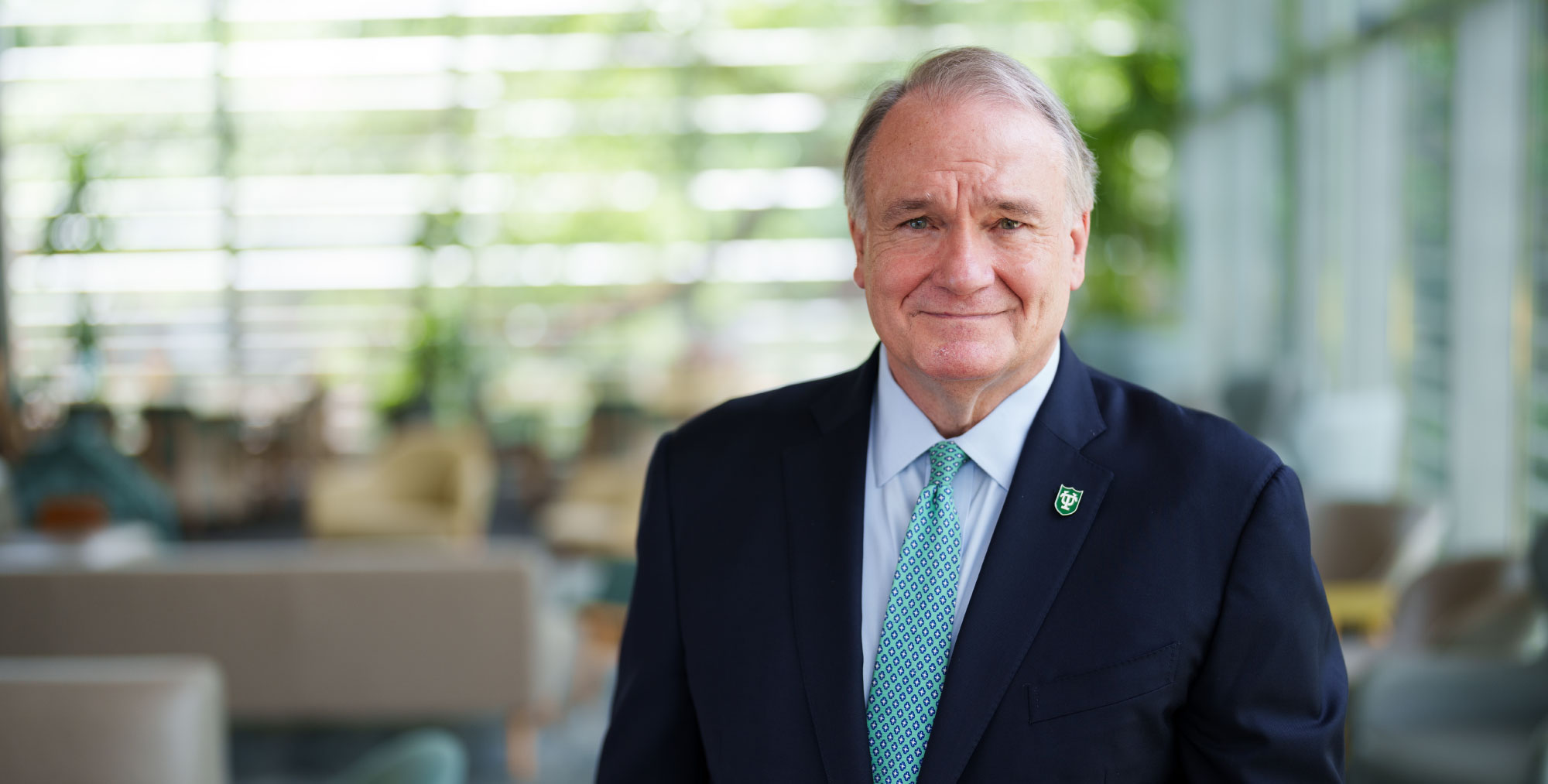
About President Fitts

Michael A. Fitts, one of the country’s foremost higher education leaders, is the fifteenth president of Tulane University. Since joining Tulane in 2014, President Fitts has repositioned the university by capitalizing on its distinctive strengths: a unique history and location; an ideal size and academic structure; and an innovative and relational culture. Under his leadership, by leveraging these attributes Tulane has become a world-class academic environment that fosters path-breaking interdisciplinary research, innovative teaching, a welcoming campus culture, and a holistic student experience.
Promoting Pathbreaking Research across Disciplines
Founded as a medical college to combat the yellow fever epidemic in the early 19th century, Tulane’s research mission has always been outward-facing and focused on the public good. Fitts has revitalized this mission by encouraging the dramatic expansion of Tulane’s research enterprise to confront many of society’s most complex challenges–current and future.
During his tenure, Fitts has recruited over ten nationally acclaimed academic deans and a vice president for research. Concurrently, he has established ten endowed presidential chairs, recruiting some of the world’s most innovative thinkers and researchers to Tulane. He has bolstered administrative and financial support for research across the university while launching numerous groundbreaking interdisciplinary research centers and programs including the ByWater Institute, the Brain Institute, the Energy Institute, the Translational Science Institute, the Center for Clinical Research, the Connolly Alexander Institute for Data Science, the Center for Cellular and Molecular Diagnostics, the Center for Environmental Law, and Research Centers of Excellence in infectious disease, personalized health and genetic modifiers in medicine. These hubs for learning and discovery combine faculty from the breadth of Tulane’s schools and disciplines to work on many of the world’s most intractable problems, while also providing unique undergraduate and graduate research opportunities. As a result of these efforts, federal funding for Tulane research has risen by 74 percent over the past seven years, with similar growth expected over the next few years. In fall 2024, President Joe Biden and First Lady Jill Biden visited Tulane’s uptown campus to announce a bipartisan cancer moonshot grant of up to $23 million to an interdisciplinary team of Tulane researchers.
Tulane’s research efforts are resulting in a dramatic expansion of the downtown New Orleans campus, which may be the most ambitious university project to date. Previously home to three of the university’s schools, the new campus is ultimately expected to house four schools and a new nursing program, with over 20 buildings overall. In fall 2024, the university announced the naming of the Celia Scott Weatherhead School of Public Health and Tropical Medicine in recognition of landmark lifetime giving that will establish the school as one of the top such programs in the world. The School of Medicine is undergoing a comprehensive renovation of its research laboratories in the Hutchinson Building. Tulane is also moving forward with the redevelopment of the iconic Charity Hospital building as the hub of a new bioinnovation corridor. As the anchor institution of the million-square-foot building, Tulane will see a significant jump in its research capacity while creating new opportunities for collaboration and innovation. The revitalized Charity will also house the Innovation Institute, launched in 2022, which supports Tulane and community scientists and entrepreneurs in bringing groundbreaking innovations and ideas to market faster. The Charity redevelopment and the Innovation Institute launch are occurring simultaneously with the recent historic partnership of Tulane health with LCMC Health. These multiple initiatives, which dramatically expand the university’s medical footprint and capacity for translational research, are intended to improve health outcomes and make New Orleans a center for destination health. They are poised to have a transformative impact on the surrounding community— and the world.
Enhancing the Student Experience
Shortly after arriving at Tulane, Fitts established a task force to strategically consider ways to enhance the student experience. This work led to a number of initiatives that are transforming the ways students live, learn, and build community.
Fitts’ master plan for the university includes a new residential quadrangle known as “The Village,” which is dramatically increasing on-campus residential capacity while intertwining opportunities for living and learning. With faculty-in-residence, study lounges, a multipurpose theater and more, the new residential spaces enrich the student experience by promoting cross-cultural, cross-disciplinary, and social-academic interactions. Representing the completion of Phase I of The Village, River and Lake Halls came online in fall 2023, with Phase II— Avron and Wendy Fogelman Hall and Bayou Hall— scheduled to open in fall 2025. In addition, as president, Fitts has increased funding for and launched new programs to support career services, academic advising, success services, and student retention.
Fitts believes that the most innovative teaching, learning, and research occur when examining issues through a variety of lenses across different fields. He has encouraged the development of new pathways for high-achieving undergraduates including the College Scholars Program, which pairs sophomores with faculty mentors to explore critical issues and build community, and the Tenenbaum Tutorials, which connect students with faculty tutors who supervise independent research projects. Students also benefit from personalized guidance from the new Office of Fellowships Advising, which supports them through the process of applying to nationally competitive scholarships and fellowships.
Tulane’s unmatched student experience, discipline-spanning curriculum and unique, relational culture have triggered a surge in interest by prospective students. As a result, the university’s selectivity has dramatically increased, with the percentage of undergraduate students admitted dropping from 25 percent in 2016 to 14 percent in 2024. At the same time, the number of accepted students who choose to attend Tulane has roughly doubled– from 23 percent in 2016 to 41 percent in 2024.
Graduate student life is enriched by the new, centrally located downtown apartments at Thirteen15, which features study and social spaces along with Chapter IV, the newest restaurant from the legendary Chase family. The Wave City Market food hall and the new downtown fitness center are additional steps towards realizing Fitts’ vision of a cohesive downtown campus that builds community and offers a comprehensive set of amenities for students, as well as faculty and staff. Graduate admissions are also on the rise, thanks to unparalleled opportunities for graduate students to work with world-class researchers to solve the world’s problems while engaging with the vibrant culture and community of New Orleans.
Supporting Academic Excellence and Opportunity
Fitts recognizes that the hallmark of a great university is the pursuit of academic excellence, and that this goal is advanced by bringing together students, faculty, and staff from a broad array of backgrounds to live, learn, and discover. He is committed to advancing intellectual rigor, learning, and scholarship by growing opportunities and building a welcoming environment for all members of our community.
Since joining Tulane, Fitts has increased financial aid and invested in programs to make a Tulane education more accessible and affordable to students from all backgrounds. One such program, Louisiana Promise, was launched to provide debt-free financial aid packages to Louisiana high school graduates whose families make less than $100,000.
As noted above, Fitts has worked to ensure that all Tulane students have the support they need to thrive, overseeing the expansion and strengthening of services ranging from academic advising to career counseling to success coaching. The Office of Academic Excellence and Opportunity was created to forge partnerships with programs, schools, and departments university-wide to promote success and positive outcomes for all students and employees.
To support and grow Tulane’s faculty and staff, the Tulane Leadership Institute was launched to identify and nurture future university leaders. Offering a robust menu of experiential leadership programs, evidence-based coaching, and professional development assessments, the institute’s three tracks are designed to align individual professional growth with university values and aspirations.
Creating a Vibrant, Renewed Physical Campus
Fitts initiated the creation of a master plan for a 21st-century campus redesigned to spark creative collisions, foster collaborations, and build community. Under his leadership, Tulane’s campuses are undergoing $1 billion in additions and upgrades.
In downtown New Orleans, where the university has long had a presence, Tulane is transforming from a collection of buildings into a vibrant, bustling, downtown university community. Recently completed capital projects downtown include a new university police station, the Stewart Center for Executive Education, the TUFit Downtown Fitness Center, Wave City Market food hall, Chapter IV restaurant, and Thirteen15 graduate student housing. The Carol Lavin Bernick Downtown Investment fund, established in 2023, is transforming the downtown campus with $5 million dedicated to encouraging collaboration, socializing and community through major landscaping and streetscaping improvements. Tulane’s long-term plans downtown include the redevelopment of the iconic Charity Hospital building. As the anchor institution, Tulane will gain essential new laboratories and research spaces, classrooms, and administrative offices, including the permanent home of the new Innovation Institute. The mixed-use building will also house apartments, retail space, and dining, drawing in the surrounding community. New additions to Tulane’s picturesque uptown campus include the Malkin Sacks Commons, a state-of-the-art, 77,000-square-foot dining facility connected to the Lavin-Bernick Center for Student Life; the Goldring-Woldenberg Business Complex; Mussafer Hall, which unites academic advising, career programming and success services under one roof; the Goldman Center for Student Accessibility in Howard-Tilton Memorial Library; the Steven and Jann Paul Hall for Science and Engineering, including three floors of interdisciplinary research labs; the Don and Lora Peters Academic Center for student-athletes; renovation of the Richardson Building as a new home for the Carolyn Barber-Pierre Center for Intercultural Life and School of Professional Advancement; a comprehensive renovation of Richardson Memorial Hall, home of the School of Architecture; and The Village, a new undergraduate housing quadrangle that will include four brand-new residential buildings, representing the largest capital investment in Tulane’s history.
At the Tulane National Biomedical Research Center in Covington, Louisiana, the university recently completed a $6 million renovation to its surgical facility, adding advanced imaging capacity, four biosafety level-2 laboratories, and expanded office space. In summer 2024, the university broke ground on a new administrative building to enhance the work environment for faculty and staff who have operated from temporary buildings as the center’s growth outpaced its physical footprint.
Securing a Robust Financial Future for Tulane and New Orleans
Fitts believes that Tulane’s collaborative spirit extends far beyond the physical boundaries of its campuses. Tulane’s location in New Orleans enhances its vitality, innovation and creativity. Likewise, New Orleans has a rich past and bright future as home to a major national research university like Tulane.
A recent report estimated Tulane’s annual impact on the region at $5.2 billion, an increase of over $2 billion from the previous report in 2019. As one of the largest private employers in the state of Louisiana, Tulane supports more than 30,300 total jobs statewide – 17,260 in New Orleans alone. In 2023, Forbes ranked Tulane as the state’s top employer on its annual “Best Employers by State” list, which considers working conditions, salary and potential for growth. In 2024, Forbes named Greater New Orleans as the #1 Best Place in America for College Students and Graduates.
Recognizing that the fates of Tulane and New Orleans are inextricably linked, Fitts’ vision for the holistic revitalization of Tulane’s downtown campus includes a drive to diversify and strengthen the local economy. By investing over $600 million to develop a bioinnovation corridor and an idea economy, Tulane expects to transform the region with an influx of new capital, investments and talent.
Fitts has worked to ensure that Tulane will benefit from a secure and robust financial future. After conducting a detailed review, Fitts restructured the university’s financial operations, balancing the budget within two years of his arrival. As part of this restructuring, he led the university’s transition to a responsibility-centered management financial model. To date, Tulane continues to achieve positive operating margins each year – a sustained, positive financial record unmatched in prior decades. Since Fitts’ arrival, the university has seen its Standard & Poor’s financial rating rise from B to A+ and its Moody’s credit rating upgraded from A2 to A1. According to Forbes, “Among top-tier colleges, few have improved in financial strength as much as New Orleans’ Tulane University,” while Moody’s cited “Tulane’s notable strengthening of brand and strategic position in recent years.” Through the Only the Audacious campaign, launched in 2017 and transitioned into Always the Audacious in 2023, over $1.7 billion has been raised – breaking all school records, exceeding the campaign’s goal, and more than doubling the university’s endowment, from just over $1 billion to about $2 billion today. The performance of Tulane’s endowment also ranks in the top decile of all universities over the last decade.
More About President Fitts
Fitts also holds the position of Judge René H. Himel Professor of Law. He is the past president of the Louisiana Association of Independent Colleges and Universities and past chair of the American Athletic Conference. Prior to coming to Tulane, Fitts served 14 years as dean of the University of Pennsylvania Carey Law School, where he was also the Bernard G. Segal Professor of Law. As dean of Penn Law, Fitts was recognized for greatly expanding the school’s offerings in interdisciplinary education. He presided over a quadrupling of the school’s endowment, a more than 40 percent increase in the size of the faculty, and a doubling of all forms of student financial aid. He oversaw the rebuilding or renovation of the entire law campus. Penn Law’s Board of Advisors named a faculty chair, a scholarship, and an auditorium at the school in his honor.
Fitts’ teaching career began at Penn Law in 1985. He has written extensively on presidential power, separation of powers, executive branch decision-making, improving the structure of political parties, and administrative law. He served as president of the American Law Deans Association. He has published numerous articles, book chapters, and reviews in the nation’s leading law reviews, including the Yale Law Journal, Michigan Law Review, Georgetown Law Journal, and the University of Pennsylvania Law Review.
Fitts grew up in Philadelphia. He earned a bachelor of arts degree from Harvard University in 1975. Inspired by To Kill a Mockingbird and its heroic protagonist Atticus Finch, he attended Yale Law School, where he was an editor of the Yale Law Journal and received his juris doctorate in 1979. He served as a clerk for federal judge and civil rights advocate Leon Higginbotham, who became a lifelong mentor to him. Fitts then worked as an attorney in the U.S. Justice Department’s Office of Legal Counsel, which serves as outside counsel to the President, White House, and Cabinet. He and his wife, Renée J. Sobel, Esq., have two adult children and two grandchildren.